follow us on:

      follow GPI Design on Google Plus  follow GPI Design on Pinterest

Beneath the Surface Blog


Thursday Salute to Originals: Coffee Bean Inspires Café Interior

GPI Design - Thursday, May 23, 2013

In this moment of modern history, we’ve become quite accustomed to visiting contemporary, hip places, but it is a rarity to walk into an establishment and think to ourselves that the design is truly unique in the hospitality arena. This is precisely what was accomplished by design firm Innarch in Kosovo with their crafting of the interior spaces at Don’s Café.

The interior concept was based on a sack of coffee beans and is a playful take on the idea. The tables and lamps represent asymmetrically aligned coffee beans and they even go so far as to coat the columns in the space to mimic the texture of the exterior of a coffee bean sack. Not only is Don’s Café a good design, but it is also a good marketing tool because it creates a buzz from word of mouth around an “unusual” looking interior, helping to differentiate it from other run of the mill coffee shops.

The most unique feature in the shop is the partition wall that serves both a decorative and functional purpose in that it provides a striking visual aesthetic and provides seating for patrons. Because of its unique form, each piece of the wall had to be individually designed, cut and assembled to make the composition work effectively. The entire composition consists of 1365 custom pieces of plywood and is a shining example of how to design unique customer experiences. Salute!

Image credits: Contemporist

Thursday Salute to Originals: Modern Design of Mayan History

GPI Design - Thursday, May 16, 2013

To present Mayan civilization in a dynamic audio and visual medium, an interactive media installation at the recently constructed Gran Museo del Mundo Maya conveys cultural developments over time. The goal of the exhibit was to represent the Mayan diaspora not as archaeological vestiges, but as a living culture that exists today. Given this focus, video painting and multimedia technology have been blended to evoke Mayan culture in an animated narrative that spans from the birth of our planet, through the history of mankind, to the emergence of contemporary societies today.

Backlit Facade Illumination at Gran Museo del Mundo Maya

The Gran Museo del Mundo Maya building itself, designed by Mexican based firm Grupo Arquidecture (formerly 4A Arquitectos), was designed around Mayan beliefs as opposed to contemporary aesthetic principles. The program was based on the ‘Ceiba’ plant, a sacred tree in Mayan culture. The structure prominently features an oval mass hoisted high above the ground wrapped in green-tinted facade elements that represent the foliage spreading out, protecting and shading the functions underneath.

Multimedia Lighting Design Facade Treatment

The exterior of the museum showcases a presentation of images the in the form of an animated fresco on the exterior of the museum. This interactive piece, created in collaboration between video painter Xavier de Richemont and multimedia lighting design firm XYZ Technologie Culturelle, is accompanied by an audio track of ancient and modern sounds. “XYZ’s multimedia installation offers visitors a chance to literally immerse themselves in this symbolic narrative. Sixteen high-definition projectors animate the upper part of the museum façade with a virtual strip that unfurls 34 giant tableaus composed of drawings, photographs, and graphic compositions by de Richemont. A long-range sound system, integrated into the building’s architecture, broadcasts the show’s music throughout the site,” according to Contemporist.

Gran Museo del Mundo Maya Exterior Facade Design

Video Animated Lighting Design Illuminated Facade Technology

As designers strive to connect buildings to unique contexts and cultures, this project inspires the use of emerging technologies to express those histories. We salute this intersection between modern lighting design, art, and architecture to achieve a rich narrative expression!

Image credits: Contemporist

Thursday Salute to Originals: High Arctic

GPI Design - Thursday, May 09, 2013

It was once said by a famous comic book character that, “with great power, comes great responsibility” and as modern humans in the living in the 21st century we’ve never had such unprecedented power to change our environment. With that power we need to be very cognisant of the effects we’re having on our planet… enter United Visual Artists.

The installation High Arctic was born from a collaboration between United Visual Artists and London’s National Maritime Museum. The two groups aim to bring awareness to a pressing issue that we all face, climate change and the diminishing Arctic ice caps. Many scientists and climatologist predicts, based on the results of supercomputers’ algorithmic data, that by the end of this century the Arctic ice will be completely melted. This kind of drastic change will have devastating effects on the planet such as, extinction of species like the Polar Bear, rising sea levels which could inundate low lying coastal areas, and create more erratic weather patterns due to the infusion of colder waters in the North Atlantic currents.

The exhibition takes place in London in a 130 x 56 foot room and is set in the theoretical year of 2100. In said room, there are 3,000 white pillars, each of which represents the over 2,500 glaciers that exists in the arctic archipelago currently. The space was designed to be immersive and give individuals a firsthand view of the damaging effects climate change is having on the planet. Visitors are given a special torch, a UV flashlight, that allows one to interact with the space. These flashlights trigger computer generated animations from 10 ceiling mounted cameras and 10 projectors as the individual navigates through the exhibition.

Also while in the space a poem is narrated about the 1,500 year history of the glaciers and about the impending demise within the next 80 years or so. “It is more of a sensory, emotional space — something that is more of a playful, musical, visual experience rather than just being a lecture,” said Ash Nehru, Software Director and Co-Founder. The entire production is innovative in that it combines modern software and technologies like motion tracking with timeless methods of narration such as poetry and music. The experience that really makes us stop to ponder the human effects on the environment.

Image credits: Design Boom

Backlit Wood Walls Nominated for Lighten Up! Award

GPI Design - Tuesday, May 07, 2013

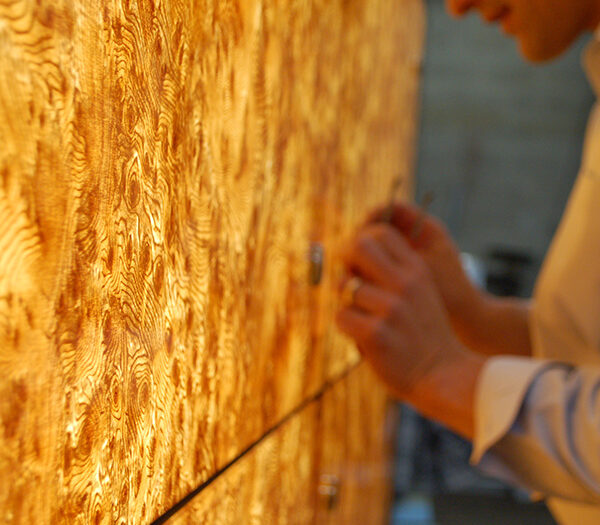
We are proud to announce that the backlit wood walls at the National Cancer Institute have been nominated for a lighting design award. The Lighten Up! LED Lighting Design competition is sponsored by Inhabitat, a popular design blog with a focus on sustainability. Our illuminated wood walls have been selected as a finalist and it is now up to public vote to decide the winner.

The GPI Design team takes personal pride in this project - it launched the development of our Oracles™ Translucent Wood Panels and we spent countless hours perfecting the details in our AutoCAD drawings, throughout the custom production, and during the installation process.  Many late nights were spent in creating this unique work of art!

Backlit Wood Walls LED Lighting Design

--> Click here to cast your vote for the National Cancer Institute 

(use the link above then click the green arrow below the writeup: "vote for this design")

Voting ends this Friday, May 10th. If you vote, leave us a comment to let us know! Thank you for your support!

Thursday Salute to Originals: Constellation Installation

GPI Design - Thursday, May 02, 2013

Having a healthy fascination with the stars as most people do, we always find it interesting when artists attempt to bring these unique celestial forms to earth. This installation is especially eye-catching to the GPI Design team for its use of backlit metal.

Backlit Metal Star Shapes Art Installation

Designed by Erich Remash, Jeremy Berglund, Don Peterson and Chad Ingle, Starlight is a sculptural installation exhibited at Burning Man, an annual art event and temporary community in the Black Rock Desert of Nevada that is based on radical self-expression and self-reliance.

Seven 12-foot diameter plywood ‘stars’ were created and placed in the configuration of the constellation Orion.  The grouping was meant to delineate a specific space in the vast and overwhelming Black Rock Desert. Aesthetically pleasing at both night and day, the installation breaks up the vacant landscape and creates a sense of curiosity for those who see it from a distance.

Glowing Start Art Lighting Installation

Starlight Backlit Metal Stars Installation Desert Art Burning Man

Orion Constellation Starlight Art Installation at Burning Man

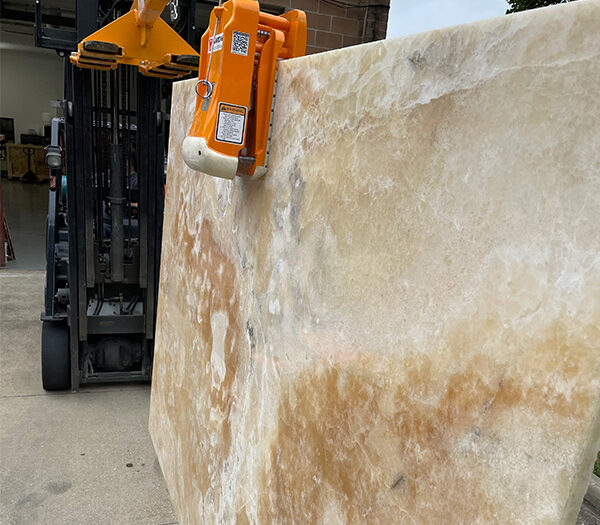
Each star has a unique lighting pattern that interacts with the landscape at night, resulting in a ‘heaven on earth’ appearance.  In considering the aesthetics, lighting patterns, site context, placement, and fastening of each piece, the designers created a constellation of uniquely glowing stars. The patterning of these stars inspires us to look through some of our old pieces of onyx to see if we can find any celestial patterns that emerge when backlit!

Thursday Salute to Originals: Redefining Marble

GPI Design - Thursday, April 25, 2013

Working with stone throughout our history at GPI has made us familiar with the wide variety of marble applications in the design industry. Besides the translucent characteristics of some stones when sliced into thin sheets - giving us the ability to backlight - the creative manipulation of stone continues to surprise designers. Kjetil Thorsen, an architect at the Norwegian firm Snohetta, has created a project meant to show just how adaptable marble really is.

Perforated Marble Stone Surface Design

As part of a showcase entitled Mutable Spirit, Thorsen’s display The Antipodes of the Lithosphere was commissioned for an Italian stone company. The installation "expresses the versatility of marble through panels which are composed of an arrangement of stone cylinders stacked to form a wall". The alignment of these cylinders and their solid-void relationship allows for an obstructed view of the wall's opposing side and interesting light patterns. Texture and visual delicacy is given to the marble object that would traditionally be perceived as smooth and heavy.

Natural Marble Stone Screen Antipodes of Lithosphere Snohetta

The project was displayed in Italy at Marmomacc, an international trade fair for operators working in the marble sector. The event showcases various types of complex stone processing and is a venue in which to highlight the natural stone materials and its inherent characteristics and potential applications.

Perforated Marble Wall Partition Design by Snohetta

We are particularly drawn to this installation for its deep consideration of what the designer refers to as the “genetic code” within stone material. While the wall partitions constitute a large volume of space, evoking images of marble in its quarried block for, the mass is punctuated by peeks through the cylindrical forms.

By keeping the relatable form but executing with this unexpected detailing method, Thorsen draws a close tie to the roots of the marble formation and elevates the possibilities of fabrication. For these meaningful design moves, today we salute Kjetil Thorsen for her insightful marble design!

Image Credits: Design Boom, Domus Web

Thursday Salute to Originals: Musical Swings

GPI Design - Thursday, April 18, 2013

The GPI Design team is always interested in creative uses of LED panels, especially when paired with innovative lighting controls. This installation is no exception. The lighting accents in this art installation show that lighting, however understated, can change the experience of installations and artwork throughout the day, creating a welcoming glow in the evening and invigorating a streetscape.

Swinging Musical Art Installation

Musical Swings Streetscape Interventino Art Montreal

Daily Tous Les Jours, a design collaborative in Montreal, Canada, produced ’21 balancires’ for the 2013 biennale international design fair in Sainte-Etienne. This public installation was available for use in the Quartier Des Spectacles, a high-traffic area in Montreal. Twenty-one swings trigger individual notes while in use and the installation is meant to “explore the notion of collaboration and the positive outcomes which can be a result of working together”, according to the designers.

Musical Design Experience Swing Lights

As users begin to swing in tandem, melodies occur according to which swings are in use and the rate at which users swing. As dusk approaches, the swings illuminate to heighten the sensory experience of its users. The ‘EmpathiCITY, making our city together’ exhibition “investigates the biennale’s theme of empathy… articulated through a series of urban interventions which turn the streets into a domain for democratic expression”, remarked an official.

“The installation offers a fresh look a the idea of cooperation – the notion that we can achieve more together than alone.” -- Tous Les Jours and Luc-Alain Giraldeau, a professor at the Université du Québec à Montréal’s Science Faculty.

Musical Swinging Playful Lighting Art Installation

The motivation behind this wonderful installation is both emotional and inspiring. We would love to see a permanent installation like this somewhere in our area so that we could take "musical breaks"!

Image credits: Design Boom

Thursday Salute to Originals: Cosmos

GPI Design - Thursday, April 11, 2013

Rarely in today’s times do people get a chance to see the stars. Whether it be from city light pollution or simply a lack of time, it’s not often that we gaze into the night sky and peer into the grand play that is the universe. The "Cosmos" lighting simulation by Leo Villareal may not encapsulate the entire universe but it does give us the opportunity to see what’s out there.

Cosmos Lighting Installation by Leo Villareal

The interactive lighting installation, located at the Herbert F. Johnson Museum of Art at Cornell University, was constructed to pay homage to the university’s late astronomy professor Carl Sagan. Composed of over 12,000 LED’s wired in a grid, Villareal programmed the exhibit to display the heaven’s illumination patterns. The software, created by Villareal himself, generates various shapes and forms to create a very unique light show. “It is especially exciting to view the installation at nighttime, when the patterns of light make the ceiling disappear and turn it into a void—light trumping matter,” said Andrea Inselmann, curator of modern and contemporary art at the Johnson Museum.

LED Lighting Ceiling Stars

A zero gravity bench, 25 feet long, was designed by the artist for viewers to fully immerse themselves in the experience and to facilitate a more communal involvement with the installation. “The challenge for me is to find a way to do it that respects what’s here but that adds another layer that can really invigorate the building and make people look at it in a new way.” Said Villareal. The installation measures in at 45’ x 68’ and is mounted on a high ceiling of the Sherry and Joel Mallin Sculpture Court to provide pedestrians clear visibility to observe from below.

LED Lighting Installation Art

The initial development of the exhibition began almost three years ago in November of 2010 when Villareal, along with project architect Walter Smith, AIA LEED AP, and donors Lisa and Richard Baker, collaborated with the Johnson Museum to find a suitable location for the installation. “It’s almost like a musical instrument that you have to tune and get just right,” said the artist. “It’s a process of discovery, because I don’t know in advance what it’s going to be.”  In this case, does context create originality?

From the Field: Illuminating a Glass Portal in NYC

GPI Design - Monday, April 08, 2013

GPI Design collaborated on a mock-up and then installation of a backlit recycled glass entry portal for a commercial office building in New York City. We are backlighting a dense recycled glass with significant natural variance and texture, which means that our backlighting solutions have to be responsive and flexible. The light blending strategies constantly changed from initial concept to mock-up to actual installation. Here is a peek into the process:

When we received the glass sample, the GPI team tested the recycled glass in our office - lots of trial, error, and creativity during this process!

Creative Process Reviewing a Glass Lighting Design Project

Diffuser pieces were handcrafted and allowed for addition/subtraction according to the characteristics of the glass.

Handcrafted LED Lighting Diffusers to Blend Light

For the mock-up, we coordinated with the glazing and metal contractors to finesse the system and detailing. The pieces were assembled as a mock-up panel for the design team to review.

Fabrication of Backlit Recycled Glass Mock up Panel

With the mock-up complete, it all goes back to the drawing board... the architect, lighting designer, GPI, glazing contractor, general contractor, and electrical contractor are marking up the shop drawings with the final details based on what we all learned through the mock-up process.

Backlit Glass Panel Design Drawings Review

Even with an extensive development process, after full installation in the final environment, the lighting still needed to be balanced and tweaked based on each piece of glass and the ambient conditions.  The GPI Design team spent five days on-site making those adjustments.

Layers of Backligting for Glass Panels

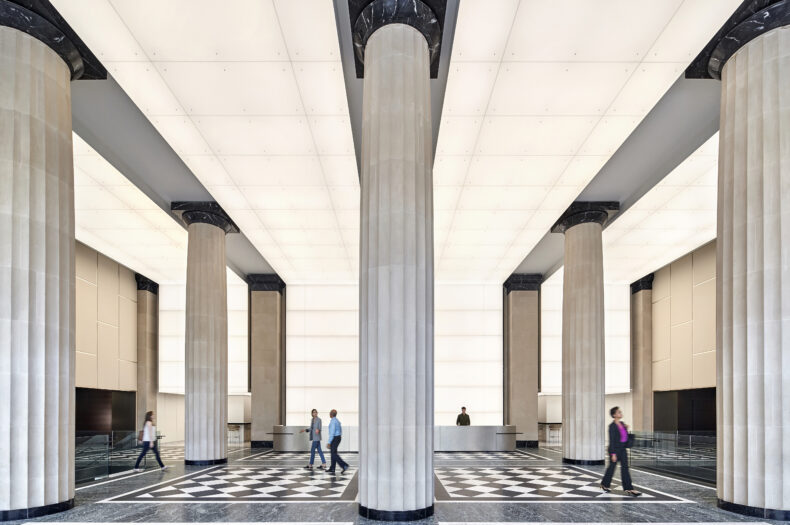
The final lighting result (surrounding finishes still in progress) - illuminated recycled glass portal that wraps from wall to ceiling.  At over thirty feet tall, the backlit glass is a celebration of the entry sequence and a beacon for visitors. Look for this lighting installation when you are near Times Square in NYC!

Backlit Glass Entry Portal Design

Thursday Salute to Originals: Fingerprints

GPI Design - Thursday, April 04, 2013

It’s no secret that fingerprints are unique. With over 7 billion people on the planet, the odds of your set of fingerprints matching someone else’s are in the quadrillions (that’s a digit followed by 15 zeros!). In other words, it’s not very likely.

But have you ever stopped to consider the impact fingerprints have on design on our perception of it? Yes, their undulating patterns can serve as a parti for buildings and designs, like this conceptual Fingerprint Building or the Fingerprint Lamp by Dan Yeffet (both below).

Fingerprint Building Design and Lighting Design

But aside from a pure visual influence, fingerprints themselves - their form, pattern, and function - facilitate a deeper, more cognitive impact on the design world, and ultimately shape how we experience and interpret it.

An intricate assemblage of ridges and valleys on the pads of our fingers create vibrations as they graze a surface, allowing our brains to deduce and qualify how a material feels. Because of these vibrations, we can differentiate between smooth and rough, scratchy and soft. Without these ridge formations, it would be difficult to articulate those variances in texture so precisely, if at all.

Fingerprint Close Up of Detail and Texture

But pattern also plays a significant role in our interpretation of a material. The elliptical patterning of fingerprints (categorized generally as arch, loop, or whorl), allows for some ridges and valleys to always fall perpendicular to the surface, no matter the angle of the fingers. This, not only creates beautifully organic and one-of-a-kind patterns from a visual standpoint, but also allows for optimum vibrations, generating a faster, more accurate analysis of a surface.

Fingerprint Black and White Patterns

Design, itself, is a very tactile process. As designers (and humans in general), we’re inherently inclined to touch, feel, hold materials in our hands; it helps us perceive them, interpret them, envision how to use them. And fingerprints are ultimately central in this ability.

So whether you’re inspired by their beautiful intricacy, or by the design principles deeply embedded within each, fingerprints are integral in the design world, allowing us to identify and connect to surfaces in such a uniquely physiological way.

Fingerprints are at the very core of our understanding of textures, and at 1 in 7 billion, they are truly Mother Nature’s own personal Salute to Originals.

Image credits: Best Buildings, Number Seventy Six, M Live, Times of News